Some of our very self-motivated to achieve pupils have attended yet another fantastic lecture at the University of Birmingham. Here, Cian in 9S1 has summarized the entire lecture for us so any who weren’t able to attend are able to learn from this amazing lecture. Thank you Cian!
“100,000 light years across the Milky Way. ‘The galaxy us nothing else but a mass of innumerable stars planted together in clusters’ -Galilea Galilei
Galactic archaeology is studying the history of the milky way using stars- Where, What, When?
Where
They used to figure out how far stars were from how bright they were. Astrometry and the structure of the milky way. 4 main components of the galaxy, thin disk, stellar halo, bulge, and thick disk. We got the data from a European space agency mission when they launched a spacecraft called Gaia, starting its mission in 2014, ending on March 27th, 2025, because it ran out of fuel for its thrusters. It is so defined that it could pinpoint a pound coin on the moon. Gya has observed over 1 billion stars, not even 1% of stars in the galaxy. Studies the movement of stars over time. 1% of stars in galaxy lets us see precision
What
Stars shine as they fuse hydrogen and helium in the core. The star doesn't change over time on the outside. We always see the same ??? the outline. A star is a collapse of gas to form a star. The cloud of gas is what the galaxy was made of. We can see the material that made the Milky Way long ago. The universe was formed with an even distribution of many elements. Processes of nuclear fusion inside the star. The energy of the star is blown off over time. During death of star during supernova, energy is released violently and quickly, possibly making new elements
When
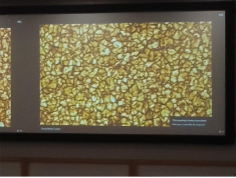
Fuses hydrogen INTO helium*. The outer layers of sun look redder as they cool down. The time when it fuses hydrogen into helium is the longest phase of its life, about 10-20 billion years. We can work out the age of a star. How to work out the size of a star? Each section in the picture is the size of Texas (Picture). Noise gets trapped inside the star as the sections move. Can't hear noise in space, how do we know the frequencies of stars then?
The disk of the galaxy is formed from the inside out. Stars formed in the middle first, died first, allowed elements to spread further ad make more stars further out. Stars interact with different galactic structures like gas clouds. We can figure out that the sun was born towards the center of the milky way because it is too metal rich compared to where we are located in the galaxy.”